


FE recruitment is in crisis, but the real problem isn't applications. It's everything that happens before them. Most colleges manage that journey across 5+ disconnected systems, and students are falling through the gaps. On 26 March, we're launching a purpose-built platform that changes that entirely.
Most FE colleges manage student recruitment across five or more disconnected systems. Spreadsheets, generic email platforms, event registration tools, shared inboxes. And they're losing students because of it.
Since 2015/16, total FE student numbers across the UK have declined by more than 16%. The demographic pipeline is tightening. Funding constraints continue to intensify. And the Office for Students has warned that, if current enrolment trends hold, more than 80% of English colleges and universities could face financial deficits within years.
The learner population only makes this harder. Unlike school sixth forms, FE colleges serve 16 to 18 year olds alongside adult returners, apprentices, ESOL learners, part-time students, and those pursuing Higher Technical Qualifications. Each cohort arrives through different channels, with different motivations, on different timelines, and needs a fundamentally different engagement approach.
Layer onto that the most significant qualification reform in a generation. The shift toward T Levels, alongside the December 2024 review that removed funding from over 200 qualifications, means colleges are managing an increasingly complex curriculum offer at exactly the moment they need to communicate it clearly. What courses are available? To whom? Through which pathway? The answers are changing year on year, and admissions teams are expected to navigate that complexity in real time.
The ability to convert interest into enrolled students isn't a secondary concern. It's an institutional priority. And yet, for most colleges, the systems governing that journey remain remarkably fragile.
Where the process breaks down
The application itself is typically well managed. Most colleges have platforms that handle formal admissions competently. The problem lies upstream, in everything between a prospective student first showing interest and submitting an application.
That pre-application journey encompasses enquiry capture, open day management, email nurturing, pipeline visibility, and family communication. In the majority of FE institutions, each function is handled by a different tool, with no coherent data layer connecting them.
The result is a process riddled with handoff points where leads go dark. A student who registers for an open day, asks a follow-up question via a contact form, and then receives a generic email two days later is not being nurtured. They're being processed inefficiently by a system that cannot see them as a whole person.
Research bears this out. A 2024 EDUCAUSE survey found that 66% of higher education CIOs identify siloed systems as a significant operational challenge. Separately, analysis of admissions operations has found that some institutions manage student interactions across more than 70 disconnected systems, each generating its own data with no shared student identity at the centre.
The downstream consequences
The effects of this fragmentation ripple across the entire institution.
For admissions and marketing teams, the absence of joined-up data makes attribution nearly impossible. Colleges invest substantially in campaigns and open days, but without source tracking connected to actual enrolment outcomes, resource allocation is driven by intuition rather than evidence. Which channels generate enquiries is knowable. Which channels generate enrolled students? That question goes unanswered.
For senior leadership, the consequence is a lack of real-time pipeline visibility. By the time enrolment numbers become clear, the window to intervene has often passed.
For IT and operations, every new tool added to bridge a gap creates new dependencies and failure points. The accumulated complexity has a real cost in maintenance, training, and institutional risk.
For student support, when application data, enrolment records, and course information live in separate systems, matching the right student to the right programme at the right time is severely compromised. Students who might have thrived with the right guidance fall through the cracks before they reach induction.
Why this is harder to solve than it appears
The instinctive response to fragmentation is integration. But connecting broken systems doesn't fix them. It relocates the problem.
The core issue is that enquiry data, event data, communication data, and application data are generated by systems that were never designed to share a student identity. Connecting them at the surface level produces dashboards that are technically populated but practically untrustworthy, because the joins are approximate, the deduplication is imperfect, and the audit trail is incomplete.
What the problem demands is a rearchitected approach: one where the pre-application journey is treated as a first-class domain, not an afterthought. Where a student's initial enquiry, open day attendance, email engagement, and application exist as a single, coherent record from the outset, not as data points reconciled after the fact across multiple exports.
What we bring to this
We haven't arrived at this problem cold. For years, we've worked deep in post-16 admissions, building tools, learning workflows, and understanding the precise points at which enrolment processes succeed or fail.
Over the last two years, we've taken that knowledge and turned it outward. We've spoken at length with admissions leads, registrars, marketing managers, and principals across FE. We've mapped the gaps. We've stress-tested assumptions. We've asked the uncomfortable question: why, in 2026, is this still being managed with spreadsheets and generic email tools?
The answer isn't that people haven't tried. It's that nobody has built the right thing yet.
What's coming on 26 March
That changes on 26 March.
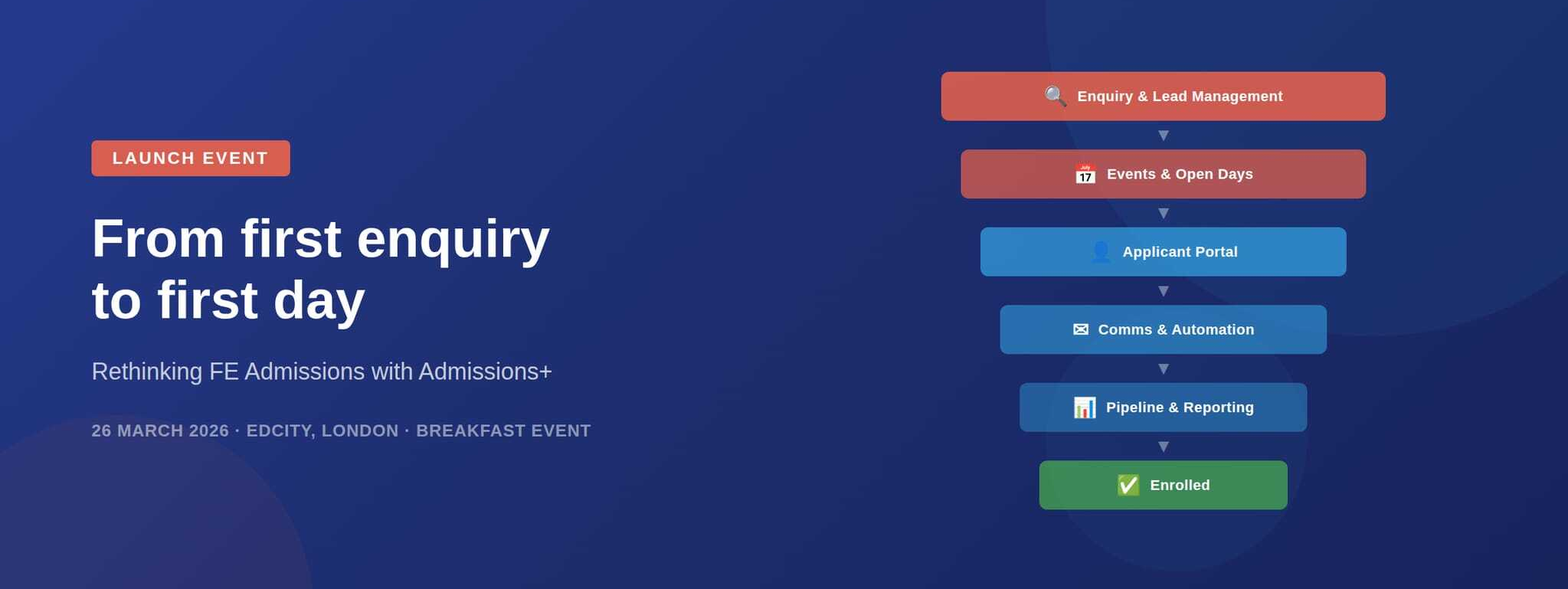
We're not patching the gaps. We're not building another integration. We're replacing the patchwork of disconnected tools with a single, purpose-built platform that manages the complete journey from first enquiry to enrolled student. Every lead tracked. Every open day managed. Every email automated. Every stage of the pipeline visible. All in one place, built specifically for how FE admissions works.
It changes everything that happens before an application. Book your place at the launch event to be the first to see it in action.
Book your place at the Admissions+ for FE Launch Event →
Join us on 26 March for the live launch. Places are limited.
This is the first in a series of posts on the structural challenges facing FE admissions, and how we're solving them. Follow along for what comes next.
Comments